

Creating moments in business
March 18, 2021
Culture of Thinking
April 12, 2021
Have you given a thought as to why bees are important to agriculture or, are you still sulking about the last bee sting?
Bees play an important role in agriculture. They help pollinate crops, increase yields, and give rise to a lucrative honey industry in South Africa and worldwide.
Bees are so important, in fact, that millions are spent renting hives to pollinate farmer’s crops. However, the role of bees in South African agriculture is threatened and this could be due to pesticides being used, especially those used in industrial agriculture. Destructive pests that invade hives and spread diseases such as the European Foulbrood also threaten their future.
An example of a pesticide that could be destructive to our bees is Neonicotinoids a group of pesticides common in the agriculture industry.
Neonicotinoids are used in the production of corn, one of our country’s important crops, as well as wheat, soy, and cotton. Pesticides such as this alter bee’s behaviour, limiting their ability to harvest nectar, and weakens the bees immune system, leaving them more vulnerable to pests and parasites. To protect essential pollinators such as bees, producers are advised to avoid using products such as this.
Producers need to determine what pesticides they use. This can be done by following the latest Maximum residue limits (MRL) list for the specific crop grown on the property.
Furthermore, once a specific pesticide product is chosen it is essential to look on the label under precautionary statements which would provide you with information regarding how to mitigate the use of the products which could be harmful to bee populations.
If the product is harmful to bees a risk mitigation plan needs to be developed and implemented to prevent the collapse of bee populations.
Your question, what is a risk mitigation plan?
The description of a risk mitigation plan is: “Risk mitigation planning is the process of developing options and actions to enhance opportunities and reduce threats to project objectives. Risk mitigation implementation is the process of executing risk mitigation actions. Risk mitigation progress monitoring includes tracking identified risks, identifying new risks, and evaluating risk process effectiveness throughout the project.”
Risk mitigation handling options for bee populations include the following:
- Avoid: Adjust requirements or constraints to eliminate or reduce the risk. This adjustment could be accommodated by a change in the use of pesticides or using more environmentally friendly options.
- Control: Implement actions to minimize the impact or likelihood of the risk. This could include:
- Select the least harmful pesticide for bees and other insect pollinators and spray late in the afternoon or at night
- Do not spray in conditions where spray might drift onto adjacent fields supporting foraging honeybees and other insect pollinators
- Dispose of waste chemical or used containers correctly (According to SANS 10206:2010 regulations)
- Always warn nearby beekeepers of your intention to spray in time for steps to be taken to protect the bees.
- Adhere to label statements regarding restrictions for managed bee pollination.
- Always advise nearby farmers
- Watch/Monitor: Monitor the environment for changes that affect the nature and/or the impact of the risk. Monitor control measures to ensure that they are working.
Johann Wolfgang von Goethe said – “The flowers are full of honey, but only the bee finds out the sweetness”.
Let us work together to conserve these precious resources our first step being the wise use of pesticides, in part two we will explore other threats to our bee populations and how we can act together to help keep our world honey sweet. To add something for the city folks would be to add a bug hotel.
If you are willing to partake in a short survey, please follow the link below:
https://forms.gle/ZLckCU7DB4fBAJxy6
Fantastic photography by Jan Jordaan and Alheit du Toit:
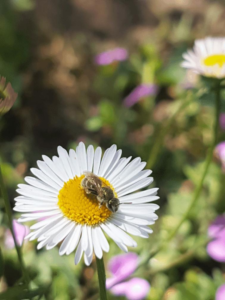
Figure 1 – Busy bee (Alheit du Toit)
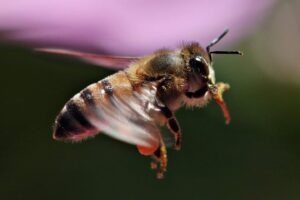
Figure 2 – Honey Bee (Jan Jordaan)
Skyvines Greetings