
Communication Matters -By Lindi Sutherland
June 1, 2026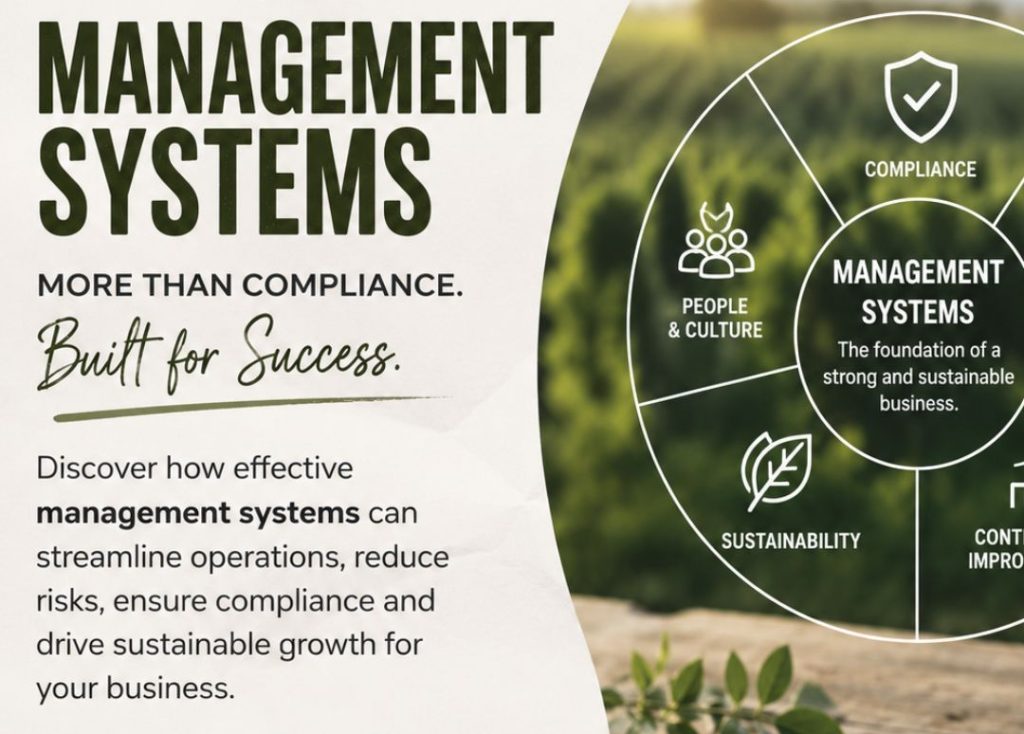
Management Systems: Turning Business Objectives into Everyday Action
By Lindi Sutherland
In our previous blog on management systems, we explored why management systems have become increasingly important in agriculture and how they help businesses manage risk, meet expectations and create value. In this article, we look more closely at how a management system turns those intentions into everyday action inside the business. When you hear the words “management system”, you might think of policies, procedures, checklists, registers and paperwork.
But a good management system is about much more than documents.
At its core, a management system is the framework a business uses to ensure that the right tasks are completed, identified risks are controlled and business objectives are achieved in a consistent way.
For agricultural businesses, this has become increasingly important. Customers, retailers and consumers want greater transparency around where products come from, how they are produced and whether risks are being managed responsibly.
This pressure has increased as farms and packhouses have become more connected to formal supply chains and closer to end consumers. Customers now expect clear proof that products are safe, legal, good quality and responsibly produced.
This includes areas such as food safety, worker welfare, environmental responsibility, product quality, traceability and legal compliance. These cannot only be addressed when something goes wrong. They need to be managed every day.
This is where a management system can add real value.
It’s more than passing an audit
Many farms and packhouses first learn about management systems because a customer, buyer or certification standard requires it. These may include GLOBALG.A.P., SIZA, BRCGS or ISO standards.
These standards provide valuable frameworks for managing risks and meeting expectations.
However, there is a danger in building a management system only around the next audit.
A business can end up with a collection of documents that meet a requirement on paper but do little to improve the way the business actually operates.
A management system should start with the business itself: its objectives, people, processes, risks and customers. Standards and customer requirements should then be built into the system where they are relevant.
Turning business goals into everyday action
A business may have clear goals for growth, profitability, market access, quality or sustainability. A management system helps turn those goals into practical actions, processes and responsibilities.
A management system closes the gap between what management wants and what happens on the ground. It turns goals into clear actions, responsibilities, checks and records, so the business can prove that important risks are being managed.
For a farm or packhouse, these risks could include:
- food safety and product quality;
- chemical use and occupational health and safety;
- environmental impacts;
- supply chain and market access risks;
- legal requirements; and
- worker welfare.
By following a systematic approach, an agricultural business is better able to manage risks, produce more consistent outcomes and increase value for customers and other stakeholders.
Creating consistency across the business
A business should not depend on one person knowing how everything works. Clear responsibilities, processes and records help ensure that important activities are carried out consistently, even when employees change, responsibilities shift or the business grows. A management system also makes accountability clearer.
When something goes wrong, the aim should not simply be to find someone to blame. Instead, the business should ask what happened, why it happened and how it can be prevented from happening again. This approach helps identify root causes and creates opportunities for improvement.
Good records and monitoring also give management a clearer picture of what is actually happening within the business. This means decisions can be based on evidence rather than assumptions.
The paperwork is only one part of the system
One of the biggest misconceptions about management systems is that the documents are the system.
They are not.
Documents are tools. They help communicate requirements, define responsibilities and provide evidence of what should happen and what has happened.
A policy sitting in a folder does not control a risk.
A procedure nobody follows does not improve a process.
And a checklist that is completed but never reviewed does not drive improvement.
The real value comes from implementation.
A management system needs to be used, monitored, reviewed and improved. It should be a living part of the business, rather than a collection of documents created for an audit and then forgotten.
Compliance is where it starts, not where it ends
Compliance is an important starting point for any management system. A business first needs to meet its legal requirements, customer expectations, internal rules and relevant standards. Once this is under control, the system can be used to improve the business.
But compliance should not be the finish line.
Once the basics are under control, management can start asking different questions.
- Can we do this better?
- Can we reduce waste or improve efficiency?
- Can we reduce risk?
- Can we improve worker welfare, environmental performance or product quality?
- Can we make better business decisions?
This is where a management system moves beyond compliance and becomes a genuine business improvement tool.
Bringing different requirements together
Agricultural businesses often work with multiple standards, customers and requirements. One may focus on agricultural practices, another on worker welfare, another on environmental management and another on food safety or quality. Managing each requirement separately can create duplication, unnecessary paperwork and confusion.
An integrated management system brings these requirements together into one practical way of working. For example, one training system, one document-control process, one corrective-action process and one management review can often support several standards at once.
The result is a system that is easier for employees to understand, easier for management to monitor and more practical for the business.
How Skyvines can help
At Skyvines, we believe management systems should work for the business and not the other way around. Skyvines helps farms, packhouses and agri-businesses understand, implement and manage the systems they need to meet customer, legal and certification requirements.
We combine experienced consultants, practical implementation support and compliance tools that help businesses improve performance, manage risk and keep market access under control.
Whether the requirement comes from GLOBALG.A.P., SIZA, BRCGS, ISO, a customer specification or another industry requirement, our focus is not simply to help create another set of documents.
Our focus is to make compliance more practical, less stressful and more useful to the business — so farmers and managers can run the business with more confidence.
The real value of a management system
Management systems are often introduced because a customer, retailer or certification standard requires them. But their value can go far beyond that requirement.
When designed and implemented correctly, a management system becomes part of the way a business operates. It connects business strategy with day-to-day activities, helps manage risks, supports better decision-making and creates a foundation for continual improvement.
The goal should never be to have a system that simply looks good on paper.
The goal is to have a system that works in practice and adds value to the business.
And that is where management systems can make a real difference — and where Skyvines can help.